
Auburn Baseball Uses Data Analytics for Athlete Development
Auburn University's College of Education lab leverages data analytics and biomechanics research to enhance baseball player performance and prevent injuries.
Press Release Disclaimer: This is a press release distributed through the XPR Media network. It has not been independently verified by our newsroom.
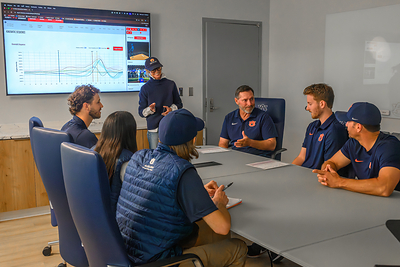

Auburn Baseball, College of Education lab leverage data to develop athletes and researchers
PR Newswire
AUBURN, Ala., Sept. 8, 2026
AUBURN, Ala., Sept. 8, 2026 /PRNewswire/ — At Auburn University’s Plainsman Park, fans can catch a baseball game with elite collegiate athletes, and behind the scenes, research is being conducted within a School of Kinesiology laboratory. Student researchers in the College of Education’s Sports Medicine and Movement Lab are collecting data on every hit and every pitch and translating that data into meaningful feedback for players and coaches.
Leading the work is Gretchen Oliver, professor and director of the Sports Medicine and Movement Laboratory, whose research focuses on injury prevention and performance enhancement in baseball and softball athletes, helping athletes stay healthy while playing at their highest level. Through a combination of lab-based analysis and real-time, on-field data collection, Oliver and her team are building a clearer picture of how pitching mechanics and workload impact the body — especially the shoulder and elbow.
“The Sports Medicine and Movement Lab utilizes three unique lab spaces that all contribute to our research profile,” Oliver said. “We have what we call our in-house lab, which is housed in the Kinesiology Building. We’ve also expanded to have an in-game and in-bullpen lab at Plainsman Park, and those two locations are really helping us set ourselves apart with regard to baseball research and helping coaches make real-time adjustments for performance enhancement.”
A LEADER IN THE FIELD
Cameras – hidden in plain sight – are the driving force behind the data at Plainsman Park. Markerless motion-capture data are collected on pitchers and hitters – both on the field and in the bullpen – with remarkable precision.
“Using the cameras, we are collecting data on every single pitch of every home game,” Oliver said. “We’re also collecting on every single swing of the bat.”
Oliver added that her team’s collaboration with Auburn Baseball is just as critical as the data collection work.
“It’s not just what the lab is doing; it is a joint venture,” she said. “I can tell you about the mechanics that I see from the data. However, our collaboration with the pitching coach, with Head Coach Butch Thompson, with all the support staff of the athletic trainers, sports medicine, and strength and conditioning, allows us to make a difference in player development. We can focus our data on each individual athlete.”
What kind of insights can student researchers glean from the data? Using advanced statistical modeling, Oliver said her team can compare mechanics, monitor fatigue, identify potential injury risks, and assess athlete development. Using their expertise in data analysis, researchers in the Sports Medicine and Movement Lab are continuously developing new methods and metrics to better target player development and injury prevention.
“We are collecting enormous amounts of data between our three lab spaces,” Oliver said. “But it’s just data. It really takes the knowledge and training of our students to turn the data into usable information that can help us move forward in assisting athletes. Much of the work being done by my students mimics what is happening on baseball’s biggest stage: Major League Baseball.”
For Auburn Baseball, this partnership supports athlete development and has contributed to the program’s success, especially in pitching.
“Auburn’s baseball biomechanics program through the School of Kinesiology is one of the top programs in the country in large part to Dr. Oliver,” said Auburn Baseball Pitching Coach Everett Teaford. “Her reputation in the baseball community makes her program one of the most sought-after degrees. Because of her reputation, she has been able to attract extremely high-level students to Auburn that have been a massive part of our success.”
IDENTIFYING INJURIES
Oliver’s lab takes a specialized approach, focusing exclusively on the biomechanics of baseball and softball. For baseball players — particularly pitchers — the repetitive stress placed on the arm presents a significant area of concern — with injuries most experienced in the elbow. In softball, injuries are more prevalent in the shoulder.
By analyzing how forces move through the body during pitching, Oliver’s research aims to identify inefficiencies and high-risk movement patterns before they lead to injury. The ultimate goal is to help athletes build safer, more sustainable mechanics.
“We do this by making sure that we have solid mechanics from the ground up,” she said, again noting how a defining feature of the Sports Medicine and Movement Laboratory is its close collaboration with coaches, athletic trainers, strength and conditioning staff, and sports medicine professionals.
“We work with coaches and really listen to understand what the coach and athlete need, and then we look at our complex data set and translate it for them, where within one sentence it makes sense,” she said.
DATA AND HEALTHCARE: BRIDGING THE GAP
That translational piece doesn’t stop with coaches, athletes and team support staff, though. Oliver frequently works alongside healthcare professionals and physicians to help them better understand how these injuries are occurring and how her team’s published research is moving toward better sports medicine options for youth through collegiate athletes.
For students and researchers working in the lab, this environment offers a unique opportunity to see how academic research can directly inform real-world decision-making.
Beyond its impact on current athletes, Oliver’s work is helping prepare the next generation of professionals in biomechanics and sports medicine. She emphasizes the importance of curiosity and a willingness to learn across disciplines.
“If my students have an intellectual curiosity about this work, they’re going to want to learn as much as they can,” she said. “I encourage them to study our research data, going back 15 years, and look for research questions that they want to solve. That is how we keep moving forward and how we continue to become better every day – by continuing to look at what we know and what we don’t know and finding ways to bridge the gap.”
IMPACTING THE INDUSTRY
Graduates from Oliver’s lab are working across the country in academic, athletic and research settings to continue to build upon the knowledge they learned at Auburn.
“I have former students serving in roles across MLB, including with the Boston Red Sox, San Diego Padres, Texas Rangers, and Florida Marlins, in addition to alumni who are working in the biomechanics industry and in university settings, both conducting research and working with collegiate athletics organizations,” Oliver said. “Seeing my students succeed at such a high level motivates me to continue to invest in students and this work.”
At its core, Oliver’s research is driven by a simple but powerful goal: keeping athletes healthy and engaged in the sports they love.
“You want the kid to have fun,” she said. “We want to identify ways to keep kids healthy at a young age so they can continue to have fun and participate in sports. When injuries sideline kids at a young age, they are likely to face more problems down the road, and that’s what we’re hoping to prevent.”
Through innovative technology and collaborative partnerships, the School of Kinesiology in Auburn’s College of Education is advancing the science of movement for the betterment of athletes — right where research meets the field.
“My passion for this research started with figuring out why athletes have the injuries they have and wanting to find a way to mitigate those injuries,” Oliver said. “That passion has grown into an understanding that we can do both: advance the research that informs the field of sports medicine, while also ensuring athletes can stay in the game longer – injury free and with optimal performance.”
NATIONAL ATTENTION
After Auburn Baseball’s Super Regional run in 2026, and a pitching staff that was ranked among the best in the country, the partnership between Auburn Baseball and the Sports Medicine & Movement Lab is garnering national attention. Auburn University’s NCAA Public Service Announcement, shown during athletics events throughout the year, will feature the collaboration between student researchers and athletes. Selected as one of only five Auburn programs to be featured, the partnership is an exemplary illustration of what can be accomplished through interdisciplinary work.
To support the research being conducted in the Sports Medicine & Movement Lab, visit Auburn’s Giving website.
Auburn University’s College of Education, founded in 1915, offers four academic units and 60 degree options, equipping graduates for a variety of careers as educators, administrators, health professionals, counselors, rehabilitation specialists and more. The college is home to innovative thinkers and doers, working together to meet society’s education and health challenges, building better futures for all.
 View original content to download multimedia:https://www.prnewswire.com/news-releases/auburn-baseball-college-of-education-lab-leverage-data-to-develop-athletes-and-researchers-302872444.html
SOURCE Auburn University College of Education



