New Report: Surplus Tax Revenue from a Single Data Center Could Pay Every Household in a Rural County Up to $8,900 a Year
WASHINGTON, Sept. 9, 2026
Press Release Disclaimer: This is a press release distributed through the XPR Media network. It has not been independently verified by our newsroom.

New Report: Surplus Tax Revenue from a Single Data Center Could Pay Every Household in a Rural County Up to $8,900 a Year
PR Newswire
WASHINGTON, Sept. 9, 2026
Bitcoin Policy Institute proposes “data center dividends” for rural county residents funded entirely by property tax revenue counties already collect
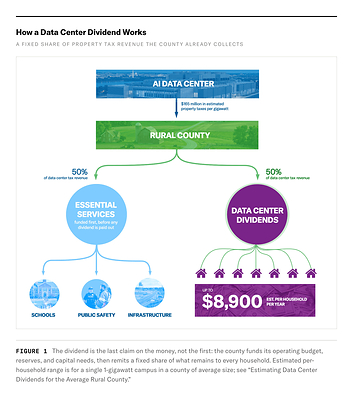
WASHINGTON, Sept. 9, 2026 /PRNewswire/ — Rural counties hosting AI data centers could pay every household an estimated dividend of $4,500 to $8,900 a year without raising taxes or adding any cost for the companies building the facilities, according to a report published today by the Bitcoin Policy Institute.
The report, “Data Center Dividends: A Financial Model to Ensure Rural America’s Economic Empowerment in the AI Age,” arrives as local opposition overtakes energy and hardware as the binding constraint on the largest U.S. infrastructure project of the decade. The number of local data center moratoria enacted across the country has risen from six in 2024 to 294 in 2026. Gallup found in March that 71% of Americans would oppose an AI data center in their area, more than the 53% who would oppose a nuclear power plant.
Author Sam Lyman, BPI’s head of research and a former senior advisor and chief speechwriter to Treasury Secretary Scott Bessent, argues that data center dividends are essential to securing rural America’s economic prosperity in the age of AI.
One jurisdiction has already come close to implementing data center dividends. In West Feliciana Parish, Louisiana, a developer has agreed to pay about $90 million a year to a county of 4,026 households with a current budget of roughly $41 million. The Louisiana Legislature passed Act 434 this spring, authorizing the parish’s taxing bodies to return data center revenue to residents. A House committee amendment removed the cash option before passage, leaving only a credit against property tax bills. But if the cash option had remained, households in West Feliciana could have received dividend payments worth between $5,600 and $11,200 every year, according to BPI’s estimates based on expected tax revenues from the data center project.
The report also derives a general per-gigawatt price estimate for data center tax revenue from Loudoun County, Virginia, the most data center-dependent jurisdiction in the country and one of the few that publishes both what data center facilities pay and how much electrical load they draw. Based on this dataset, BPI estimates that the average rural county with a 1-gigawatt campus could remit data center dividends worth between $4,500 and $8,900 to every household each year.
“Rural counties are sitting on a digital goldmine,” Lyman said. “They have the land and the power the AI economy cannot manufacture anywhere else. But they have no mechanism for turning that valuable real estate into an asset that can transform the economic prospects of every family in their communities. Until now. Data center dividends will ensure that every household in a rural county reaps the full benefits of America’s AI buildout.”
The data center dividend model borrows from the logic of sovereign wealth funds and the Alaska Permanent Fund. Financed by oil royalties collected by the Alaskan government, the Alaska Permanent Fund has paid an annual dividend to state residents for 44 straight years and currently holds $91.3 billion in assets under management. The typical Alaska resident has collected, on average, about $1,500 in dividend payments every year over the past decade.
The report offers three delivery options for data center dividends: a cash dividend, a credit against property taxes or electricity bills, or a county endowment to fund scholarships or services.
The full report is available at https://www.btcpolicy.org/articles/data-center-dividends
About the Bitcoin Policy Institute
The Bitcoin Policy Institute is a nonpartisan, nonprofit research organization dedicated to advancing understanding of emerging technology and its implications for public policy. Through rigorous research, education, and policy analysis, BPI informs policymakers, regulators, and the public about emerging technology and Bitcoin‘s role in the financial system.

 View original content to download multimedia:https://www.prnewswire.com/news-releases/new-report-surplus-tax-revenue-from-a-single-data-center-could-pay-every-household-in-a-rural-county-up-to-8-900-a-year-302874214.html
SOURCE Bitcoin Policy Institute